
Why Every Modern Computer Still Uses An Idea From The 1940s
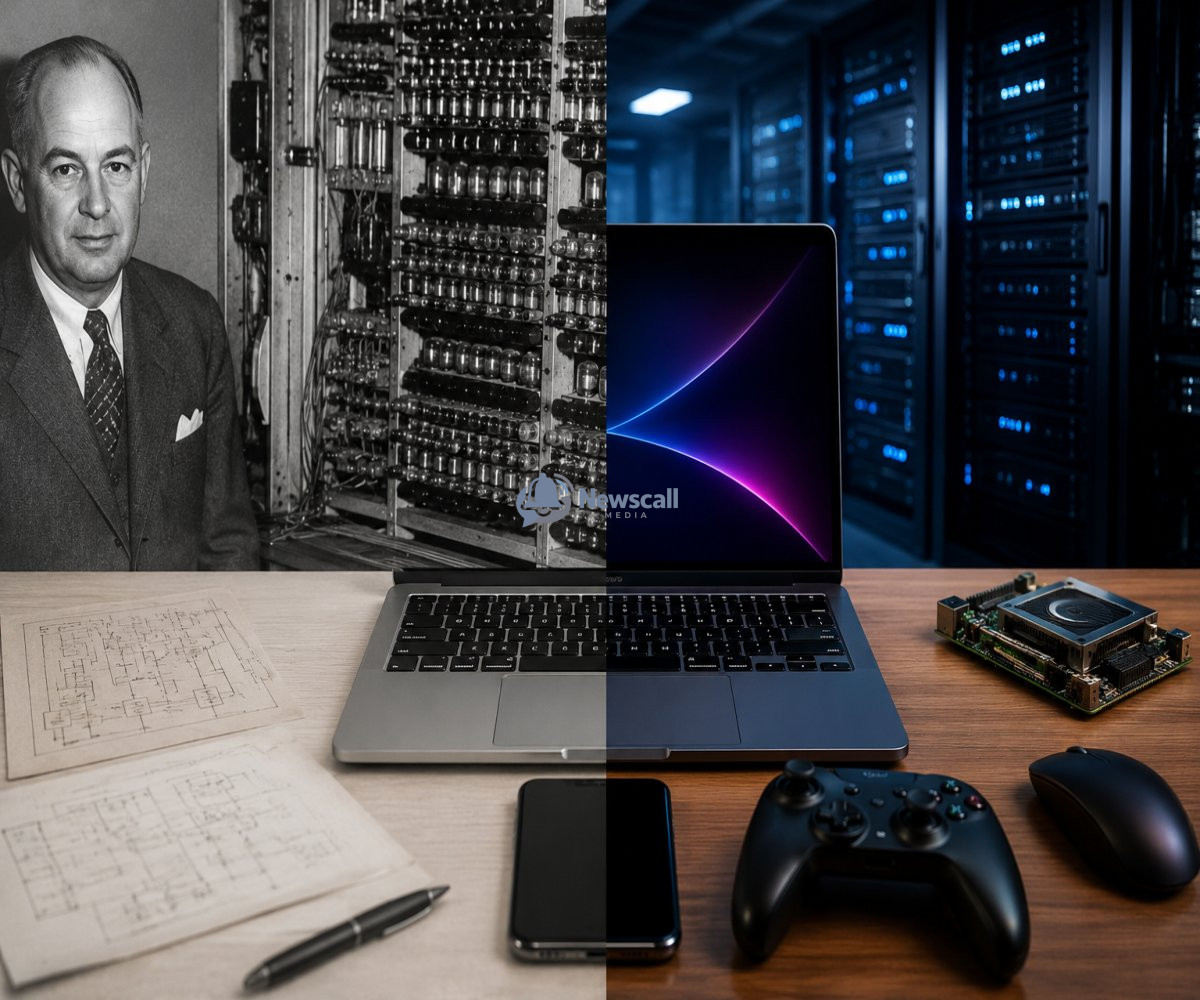
Open your laptop.
Unlock your smartphone.
Start your gaming console.
Power on a supercomputer.
Although these machines look completely different, perform vastly different tasks, and were built decades apart, they all share one remarkable secret.
At their core, they still follow an idea proposed more than 80 years ago.
In the world of technology, that is almost unheard of.
Most inventions become obsolete within years. Storage devices shrink. Processors become faster. Programming languages evolve. Entire industries rise and fall. Yet one fundamental computer design has survived every technological revolution since the 1940s.
It is known as the Von Neumann architecture, and without it, modern computing as we know it would not exist.
The story begins during one of the darkest periods in human history.
The Second World War accelerated scientific and engineering breakthroughs at an unprecedented pace. Governments invested enormous resources into mathematics, electronics, cryptography, and early computing machines. Engineers were building some of the first electronic computers to solve problems that humans could never calculate quickly enough.
These early computers were astonishing for their time, but they had a serious limitation.
Programming them was painfully difficult.
To change what a computer did, engineers often had to physically reconnect wires, flip switches, or replace components. Even simple changes could take hours or days. The computer wasn't flexible—it was almost rebuilt for every new task.
Then a revolutionary idea emerged.
In 1945, mathematician John von Neumann described a new way of designing computers while working on the EDVAC project.
Instead of treating instructions and data as separate things, why not store both inside the computer's memory?
At first, the proposal sounded surprisingly simple.
But its consequences were extraordinary.
If a computer could store its own instructions in memory, it could load different programs without being physically rewired. One machine could calculate mathematical equations in the morning, process payroll in the afternoon, and play a game in the evening—simply by loading different software.
Today, that sounds obvious.
In 1945, it completely changed the future of computing.
This became known as the stored-program concept, the foundation of the Von Neumann architecture.
Its design can be understood through five essential parts.
First is the memory, where both data and instructions are stored together.
Second is the control unit, which reads instructions one after another and directs the rest of the computer.
Third is the arithmetic logic unit, often called the ALU, which performs calculations and logical operations.
Fourth are the input devices that provide information to the computer.
Finally comes the output, where results are displayed or transmitted.
Nearly every desktop computer, smartphone, laptop, game console, and server still follows this basic blueprint.
Of course, today's processors contain billions of transistors instead of thousands.
Memory is dramatically faster.
Graphics processors perform trillions of calculations every second.
Artificial intelligence chips specialize in machine learning.
Yet underneath these astonishing improvements, the same fundamental idea remains.
Instructions and data live together in memory.
The processor repeatedly fetches an instruction, decodes it, executes it, and moves to the next one.
This simple cycle happens billions of times every second.
It is the heartbeat of modern computing.
One of the reasons the architecture has lasted so long is its flexibility.
Because programs are stored in memory, developers can create almost any type of software without changing the physical hardware.
A computer can become a word processor, a web browser, a music studio, a medical imaging system, or an AI assistant simply by installing different programs.
That flexibility transformed computers from specialized machines into universal tools.
However, the Von Neumann architecture is not perfect.
Ironically, one of its greatest strengths also became one of its biggest weaknesses.
Because instructions and data share the same pathway between memory and the processor, information can only travel so fast.
As processors became dramatically faster over the decades, they increasingly found themselves waiting for data to arrive from memory.
Engineers call this limitation the Von Neumann bottleneck.
Even today's most advanced computers still struggle with it.
Modern chip designers have spent decades inventing clever solutions.
Cache memory stores frequently used information closer to the processor.
Multiple processor cores perform tasks simultaneously.
Sophisticated prediction systems attempt to guess which instructions will be needed next.
Yet these innovations reduce the bottleneck—they do not eliminate it.
The original architecture still defines how information flows.
Researchers are now exploring alternatives.
Quantum computers process information in fundamentally different ways.
Neuromorphic chips imitate the structure of the human brain.
Some experimental systems combine memory and processing more closely to reduce delays.
If these technologies mature, they may eventually complement—or even replace—parts of the traditional architecture for specific tasks.
But for general-purpose computing, the Von Neumann design remains remarkably resilient.
Its influence extends far beyond personal computers.
Cloud servers running the world's largest websites rely on it.
Banking systems process transactions using it.
Aircraft navigation systems depend on it.
Medical equipment uses it.
Factories, satellites, smartphones, and even many autonomous robots still follow the same fundamental principles proposed during the 1940s.
That is an extraordinary legacy.
History is filled with inventions that were revolutionary for a moment before disappearing.
The floppy disk vanished.
Cassette tapes disappeared.
DVD players faded.
Even once-dominant computer companies have come and gone.
Yet an idea written on paper more than eight decades ago continues to power the digital world.
Perhaps the most remarkable part of this story is that John von Neumann wasn't trying to build the smartphones or AI systems we use today.
He was solving a problem facing the earliest electronic computers.
His solution turned out to be so elegant, so practical, and so adaptable that generations of engineers kept building upon it instead of replacing it.
The fastest supercomputer on Earth and the phone in your pocket are separated by unimaginable differences in speed and power.
But deep inside, they still speak the language of a man who imagined a better way to build computers in 1945.
That is the mark of a truly timeless innovation.
Some inventions change the world for a few years.
Others shape it for generations.
The Von Neumann architecture has quietly done both.

Victor Oluebubechukwu Akuma.
Creative writer