NASA Is About To Launch A Telescope That Could Change Our View Of The Universe
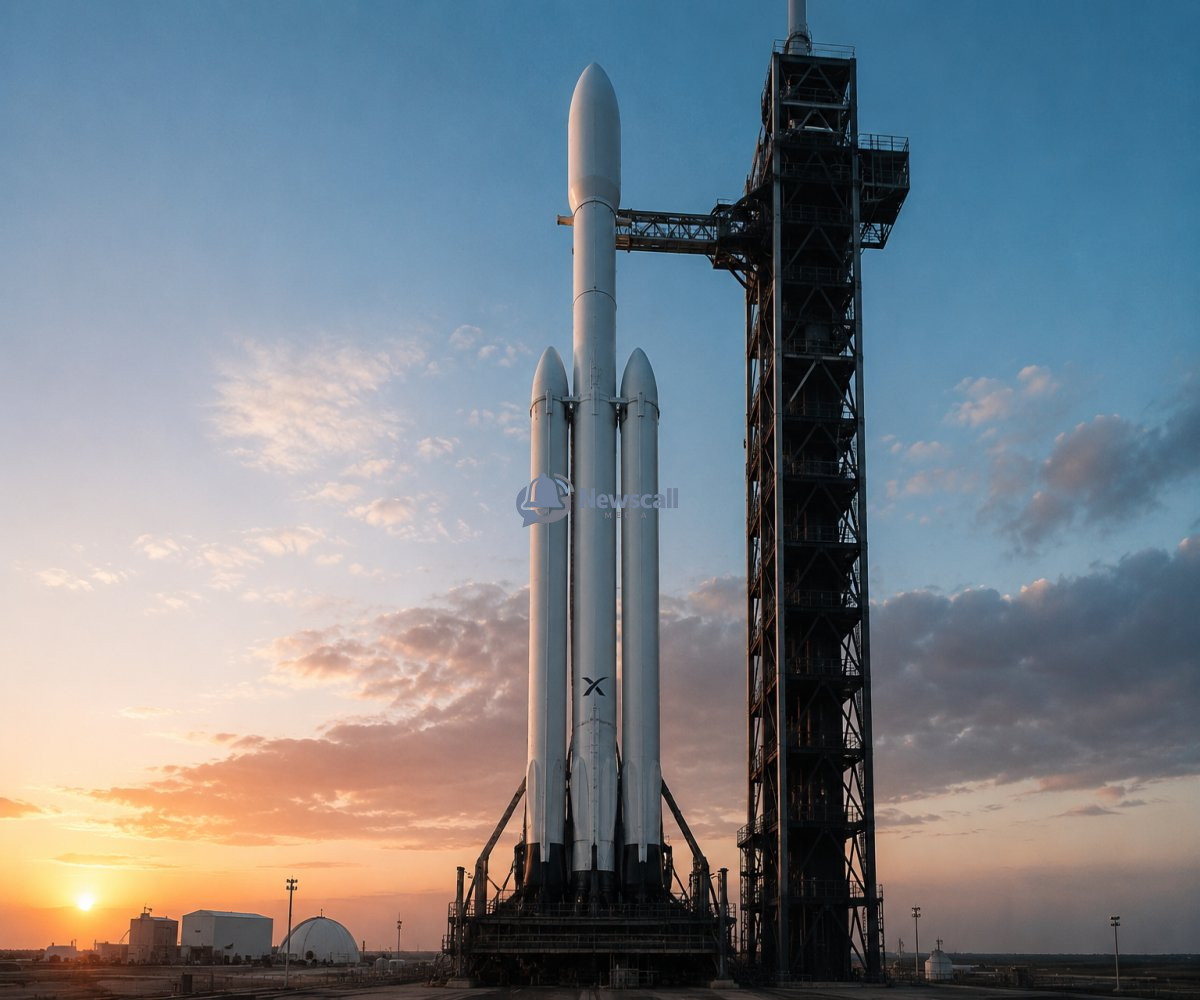
NASA is about to send a new eye into space.
On Sunday, August 30, NASA and SpaceX are scheduled to launch the Nancy Grace Roman Space Telescope aboard a Falcon Heavy rocket from Kennedy Space Center in Florida.
And this isn't just another space telescope.
Roman has been designed to survey enormous portions of the universe while investigating some of the biggest unanswered questions in modern astronomy—including what dark energy actually is, how galaxies evolved, and how common planets beyond our solar system might be.
The launch is currently targeted for 7:26 a.m. EDT, with NASA beginning live coverage about an hour earlier.
If everything goes according to plan, Roman will eventually travel roughly one million miles from Earth to a region of space called the second Sun-Earth Lagrange point, or L2.
That's the same general region where the James Webb Space Telescope operates.
But Roman isn't being sent into space to replace Webb.
It's being built to see the universe in a very different way.
And that difference could be its biggest advantage.
The James Webb Space Telescope is incredibly powerful, but Roman is designed to survey huge areas of the sky much faster.
NASA says Roman's field of view will be at least 100 times larger than Hubble's while still producing sharp infrared observations.
Think of Hubble and Webb as incredibly powerful cameras capable of taking detailed photographs of relatively small portions of the sky.
Roman is designed more like a cosmic wide-angle camera.
It can repeatedly scan enormous regions and build massive maps of the universe.
Its main Wide Field Instrument contains an array of detectors equivalent to roughly a 300-megapixel camera, allowing it to capture huge amounts of information in individual observations.
That enormous field of view could allow astronomers to study billions of galaxies and observe changes across enormous sections of the cosmos.
And that's where things get really interesting.
One of Roman's biggest missions is to investigate dark energy.
Scientists know that the universe is expanding.
They also know that the expansion appears to be accelerating.
But whatever is responsible for that acceleration remains one of the biggest mysteries in physics.
Scientists call the unknown phenomenon dark energy.
Roman won't simply take pictures of distant galaxies.
It will conduct enormous surveys designed to help scientists measure how the universe has expanded throughout cosmic history.
Those measurements could reveal whether our current understanding of dark energy is correct—or whether something much more fundamental is missing from our picture of the universe.
That could have enormous consequences for physics.
But dark energy isn't Roman's only target.
The telescope will also investigate dark matter, another mysterious component of the universe that doesn't appear to emit or reflect light but seems to influence how galaxies and larger cosmic structures behave.
Astronomers believe dark matter makes up a substantial portion of the universe's mass.
Yet nobody knows exactly what it is.
Roman's huge surveys could help scientists map how matter is distributed throughout the cosmos and improve our understanding of how galaxies formed and evolved.
Then there's another mission that could get people even more excited:
finding planets.
Roman is expected to discover enormous numbers of exoplanets—worlds orbiting stars beyond our Sun.
One of the methods it will use is called gravitational microlensing.
When a star passes in front of a more distant star, its gravity bends and magnifies the background star's light.
If a planet is orbiting the foreground star, that planet can create a tiny additional change in the light.
Roman's massive surveys will allow astronomers to detect these brief signals across huge areas of the galaxy.
Scientists expect the mission to uncover thousands of new worlds through this technique.
But Roman has something even more ambitious hidden inside it.
The telescope carries an experimental coronagraph designed to block out the overwhelming light from stars and make it easier to study the faint light reflected by planets orbiting them.
That's an extremely difficult problem.
Imagine trying to photograph a tiny, faint object sitting right beside an enormously bright light.
The star can be billions of times brighter than the planet you're trying to see.
Roman's coronagraph is designed to suppress that overwhelming starlight and test technologies that could eventually make direct observations of distant planets much more practical.
That doesn't mean Roman is about to find another Earth tomorrow.
But the technology it tests could help pave the way for future missions specifically designed to search for potentially habitable worlds.
And that may ultimately be one of Roman's most important contributions.
The telescope is expected to operate for at least five years, with enough fuel planned for a potential 10-year mission. Its scientific data will eventually be made publicly available after processing.
That means Roman won't just belong to NASA.
Its observations will become a resource for astronomers around the world.
And because the telescope will survey such enormous portions of the sky, scientists don't necessarily know everything it will discover.
That's one of the most exciting parts of astronomy.
You can build a telescope to answer one question and end up discovering something nobody was looking for.
Roman could find unexpected types of stars.
It could reveal previously unknown planetary systems.
It could expose strange behavior in galaxies.
It could uncover objects that challenge existing theories.
And, perhaps most importantly, it could provide evidence that forces scientists to rethink how the universe works.
That's what happened repeatedly with previous space telescopes.
Hubble transformed our understanding of galaxies, stars and cosmic expansion.
James Webb is now revealing galaxies and cosmic objects at extraordinary distances and providing new information about the early universe.
Roman is designed to add something different to that picture.
It will sacrifice some of the extreme detail of Webb's observations in exchange for something incredibly valuable:
scale.
Instead of staring deeply at a small patch of the universe, Roman will survey enormous areas and repeatedly return to them.
That combination of speed and scale could produce a dataset unlike anything astronomers have had before.
And the timing makes this launch particularly significant.
NASA's Roman telescope has been years in the making, with the mission surviving funding challenges and multiple stages of testing before reaching the launchpad.
Now the spacecraft is encapsulated inside the Falcon Heavy's payload fairing, sitting at Launch Complex 39A and waiting for its journey into deep space.
The rocket itself is enormous.
The Falcon Heavy stands nearly 230 feet tall and uses 27 Merlin engines across its three booster cores, generating more than five million pounds of thrust at liftoff.
But the real story isn't the rocket.
It's what happens after the rocket disappears into the sky.
Roman will spend roughly a month traveling toward L2 before entering its operational phase. After that, engineers will spend additional time commissioning and calibrating the telescope before scientific observations begin.
So the first spectacular Roman images won't arrive immediately after launch.
The real scientific payoff comes later.
And when it does, astronomers could have a completely new way of looking at the universe.
For decades, humanity has built increasingly powerful telescopes to answer one fundamental question:
What is actually out there?
Roman is designed to take that question to an entirely different scale.
It will map billions of galaxies.
Search for thousands of distant worlds.
Study the invisible structure of dark matter.
Investigate the mysterious force driving cosmic expansion.
And test technology that could eventually help humanity directly study planets around other stars.
Tomorrow, NASA plans to launch the machine that will begin that journey.
If the mission goes according to plan, humanity won't simply be looking farther into space.
We'll be looking at more of it than ever before.

Victor Oluebubechukwu Akuma.
Creative writer