
Why Humanoid Robots Are Suddenly Everywhere In 2026
For years, humanoid robots looked like something that belonged in a science-fiction movie.
They could walk. They could balance. They could pick things up. They could even perform impressive tricks for a camera.
But there was always one problem.
They weren't actually doing much useful work.
That is beginning to change.
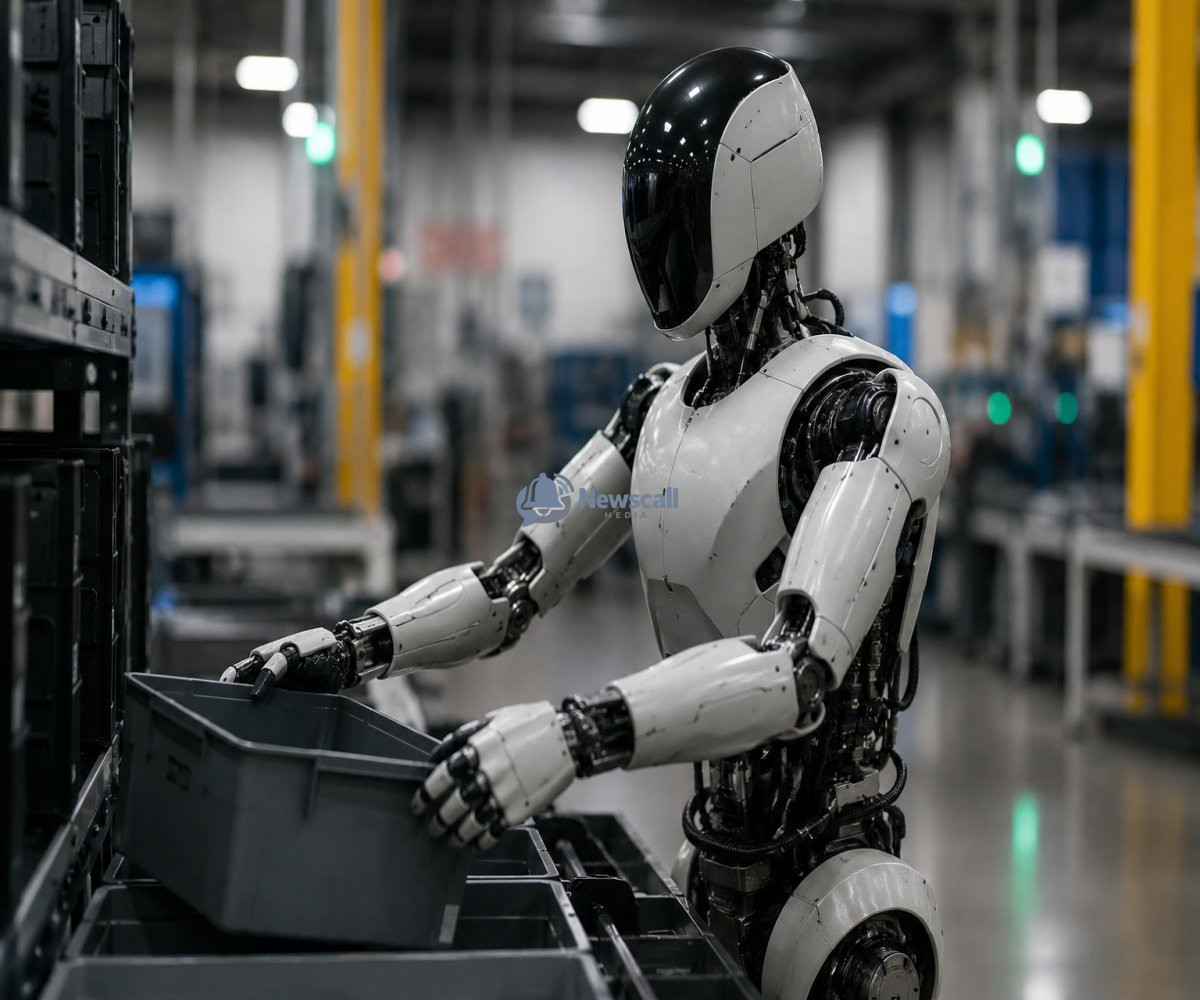
In 2026, humanoid robots are moving out of laboratories and into factories, warehouses, and commercial environments. Companies including Figure AI, Tesla, BMW, Mercedes-Benz, Unitree and others are racing to build machines that don't just look human, but can actually perform useful tasks in the physical world.
And the reason this is happening now isn't simply because robots suddenly became better.
It's because AI finally became good enough to give them something they have historically lacked: a much better understanding of the world around them.
Traditional industrial robots are extremely good at repetitive tasks in controlled environments. Give a robotic arm the same object in the same position thousands of times and it can perform the task with incredible precision.
But the real world isn't that predictable.
A box can be moved.
A part can be rotated.
Something can block a robot's view.
A person can walk into its workspace.
A task can require several different movements instead of one perfectly scripted motion.
Humanoid robots are being designed to deal with exactly this kind of messiness.
Figure AI is one of the companies pushing that idea aggressively.
Its latest humanoid, Figure 03, has already entered BMW's manufacturing environment in South Carolina. The robot is being used for a more complicated logistics task called sequencing, where parts don't necessarily arrive in exactly the same orientation or position every time. (figure.ai)
That's a significant step from simply demonstrating that a robot can pick up an object.
Figure's previous-generation Figure 02 had already spent months working at BMW's Spartanburg plant. According to BMW and Figure, it operated for more than 1,250 hours, moved more than 90,000 components and contributed to the production of more than 30,000 BMW X3 vehicles. (bmwgroup.com)
Now Figure 03 is being tested on a more complicated workflow.
The important part isn't that a robot can move a metal component.
It's that the robot is increasingly expected to understand what is happening around it and adjust its behavior accordingly.
That is where the phrase "physical AI" comes in.
Generative AI taught computers to work with words, images, code and other digital information.
Physical AI attempts to give AI a body.
Instead of simply answering a question, an AI system can perceive an environment, make a decision and control a machine that physically interacts with that environment.
That could eventually turn humanoid robots into general-purpose workers.
And the potential market is enormous.
Factories already employ millions of people performing repetitive, physically demanding, or highly structured tasks. If a robot can perform even a small percentage of those jobs reliably and economically, the market could be enormous.
This is why companies aren't waiting for humanoid robots to become perfect.
They're putting them into controlled environments and teaching them one task at a time.
BMW is already experimenting with humanoid robots in both the United States and Germany.
At its Leipzig plant, BMW has introduced AEON, a humanoid robot being tested for tasks involving battery modules and component manufacturing. The company describes the project as part of its broader "Physical AI" strategy. (bmwgroup.com)
Tesla is pursuing an even bigger vision with Optimus.
Elon Musk has repeatedly described Optimus as potentially becoming one of Tesla's most important long-term businesses.
Tesla has said production of Optimus is expected to begin later in 2026, initially using robots within Tesla itself for training and development. (marketwatch.com)
But Tesla's project also illustrates how difficult humanoid robotics actually is.
Building a robot that can perform a demonstration is one thing.
Building thousands of reliable robots that can work every day is completely different.
The hardware has to survive repeated movement.
Batteries have to provide enough energy.
Motors have to be powerful but efficient.
Hands need enough dexterity to manipulate objects.
Sensors have to understand the environment.
And the AI controlling everything has to make decisions quickly enough to prevent mistakes.
Then there's the biggest question of all:
Does it make economic sense?
A humanoid robot can be technologically impressive and still be a terrible business if it costs too much to manufacture, maintain, or operate.
That's why the factory experiments happening now are so important.
Companies aren't simply trying to prove that humanoid robots can walk.
They're trying to prove that they can create more economic value than they cost.
China is also moving extremely quickly.
At the 2026 World Robot Conference in Beijing, hundreds of companies showcased humanoid and other robotic systems. Chinese companies including Unitree, UBTECH, Leju Robotics, Galbot and others are competing to turn robotics into a major manufacturing industry. (reuters.com)
The scale of China's robotics push is particularly striking.
According to Reuters, Chinese companies delivered more than 40,000 humanoid robots during the first half of 2026, giving China an enormous share of the global market. (reuters.com)
But that number needs context.
A robot being manufactured or shipped doesn't automatically mean it is replacing human workers in a factory.
Many humanoid robots are still being used for demonstrations, research, training, or relatively narrow tasks.
The industry is therefore at an unusual stage.
The hardware is improving incredibly quickly.
The software is improving incredibly quickly.
But the robots still have a long way to go before they can reliably perform most human jobs in unpredictable environments.
Even executives inside the industry are warning that a true breakthrough could still take years.
Unitree CEO Wang Xingxing recently described a future "ChatGPT moment" for robotics as the point when a humanoid could understand a simple instruction and perform roughly 80% of tasks in an unfamiliar environment. He believes that breakthrough could still be two to ten years away. (reuters.com)
That may sound like a long time.
In robotics, it isn't.
The interesting thing about 2026 is that companies no longer need to wait for that ultimate breakthrough before finding commercial uses.
They can start with simpler tasks.
Move this part.
Sort these components.
Carry this object.
Load this machine.
Bring materials to this station.
Then gradually expand what the robot is capable of doing.
That's essentially how the industry is learning.
And it could create a feedback loop.
More robots working in the real world generate more data.
More data can improve the AI controlling the robots.
Better AI makes robots capable of more tasks.
More capable robots create more demand.
More demand leads to more production.
If that cycle works, humanoid robotics could develop much faster than previous generations of robotics.
And that is why 2026 feels different.
The humanoid robot isn't suddenly finished.
It isn't replacing humans everywhere.
It isn't walking into every factory and taking over the production line.
But for the first time, some of the world's biggest companies are seriously testing whether a general-purpose machine can become a useful worker.
That distinction matters.
The biggest breakthrough in humanoid robotics may not be a robot that can run faster, jump higher, or perform a spectacular backflip.
It may be a robot that quietly works an eight-hour shift, performs a useful task, makes very few mistakes, and costs less to operate than the alternative.
If companies achieve that at scale, humanoid robots could become one of the most important new industries of the next decade.
And suddenly, the question won't be whether robots can look like humans.
It will be whether they can work like us.

Victor Oluebubechukwu Akuma.
Creative writer