

Materials That Became Stronger After Scientists Tried to Break Them
Most people assume that breaking something makes it weaker.
Drop a glass on the floor, and it shatters.
Bend a paper clip too many times, and it snaps.
Crack a piece of concrete, and it never regains its original strength.
But in the world of materials science, there are remarkable exceptions.
Some materials actually become stronger after being stretched, compressed, hammered, or even damaged.
It sounds impossible.
Yet these unusual materials have transformed everything from skyscrapers and airplanes to smartphones and medical implants.
Here are some of the most fascinating examples.
1. Tempered Glass
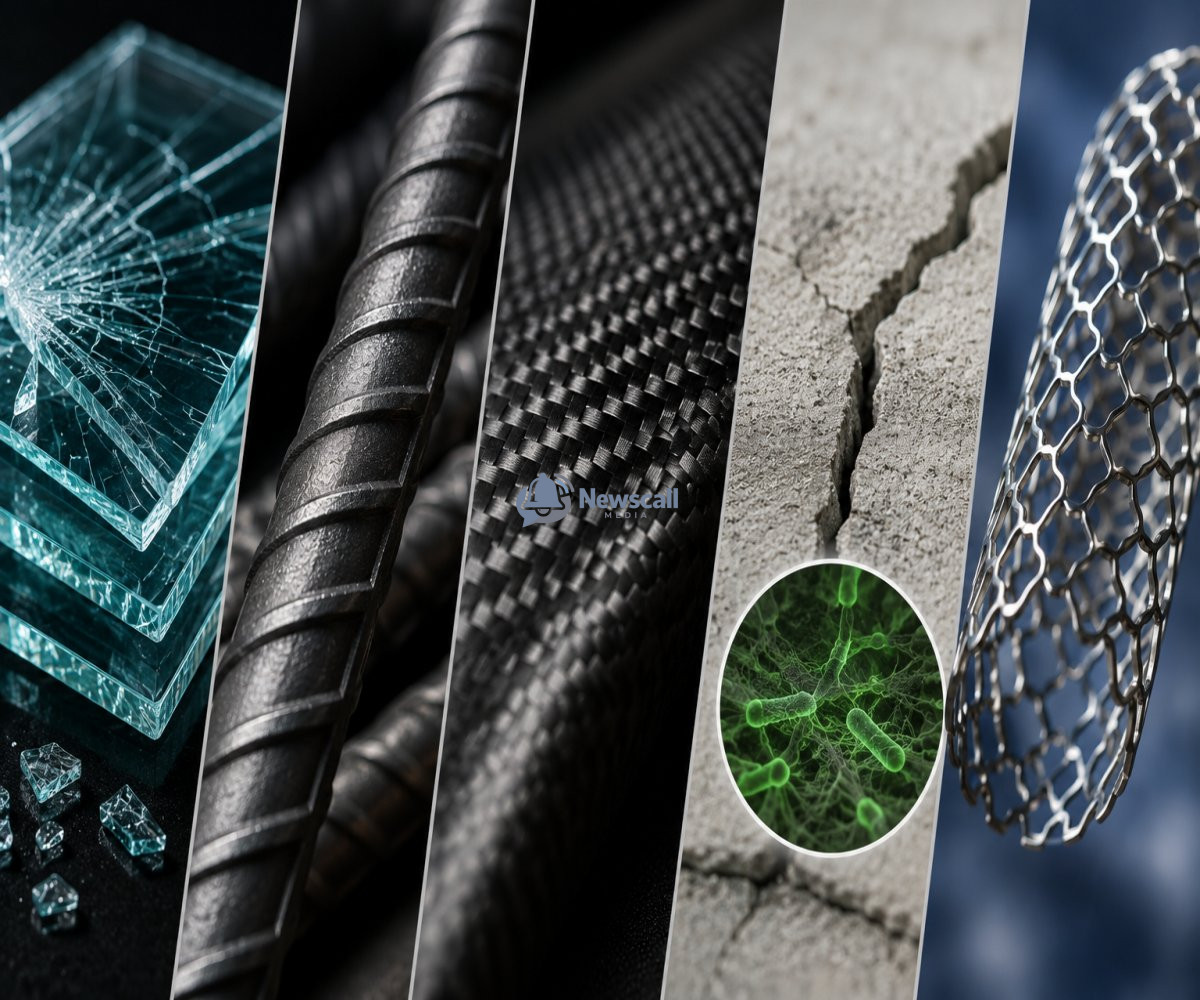
Tempered glass begins life as ordinary glass.
The difference comes after it is heated to extremely high temperatures and then cooled rapidly.
This process creates internal compressive stresses that make the surface far more resistant to impacts and scratches than regular glass.
Instead of breaking into dangerous razor-sharp shards, tempered glass crumbles into thousands of small, blunt pieces.
That's why it's used in car windows, shower doors, and many public buildings.
Scientists didn't make glass stronger by adding more material.
They made it stronger by carefully stressing it.
2. Steel Through Work Hardening
Many metals become stronger the more they're deformed.
This phenomenon is called work hardening.
When steel is bent, rolled, hammered, or pressed, tiny imperfections inside its crystal structure begin to interact.
As these defects accumulate, they make it increasingly difficult for the metal's atoms to slide past one another.
The result is stronger, harder steel.
Blacksmiths have unknowingly taken advantage of this principle for centuries by repeatedly hammering hot metal into shape.
Modern engineers still rely on it to manufacture stronger components for cars, buildings, and industrial machinery.
3. Gorilla Glass
Millions of smartphones survive accidental drops thanks to a material designed to resist cracks.
Gorilla Glass undergoes a chemical strengthening process in which smaller sodium ions inside the glass are replaced by larger potassium ions.
The larger ions squeeze tightly into the surface, placing it under permanent compression.
That invisible stress acts like armor.
Small cracks find it much harder to spread.
The process doesn't simply make the glass harder.
It makes it much tougher.
4. Carbon Fiber Composites
Carbon fiber is already known for being incredibly strong while remaining lightweight.
But its real strength comes from how it is engineered.
Thousands of microscopic carbon strands are woven together and embedded in special resins.
If tiny cracks begin forming in one direction, the surrounding fibers redistribute the load, preventing catastrophic failure.
Instead of collapsing immediately, the material resists further damage.
This is why carbon fiber has become essential in aircraft, Formula One cars, spacecraft, and high-performance sports equipment.
5. Shape Memory Alloys
Some metals don't just resist damage.
They appear to recover from it.
Shape memory alloys such as nickel-titanium can be bent, twisted, or compressed before returning to their original shape when heated.
The effect occurs because the material rearranges its internal crystal structure rather than suffering permanent damage.
Today these remarkable alloys are used in medical stents, eyeglass frames, orthodontic wires, and even spacecraft mechanisms.
They don't become stronger by breaking.
They become stronger by remembering.
6. Ceramic Armor
Ceramics are often associated with fragile objects like plates and mugs.
Advanced engineering ceramics are completely different.
Materials such as silicon carbide and boron carbide are among the hardest substances ever manufactured.
When struck by high-speed projectiles, they absorb enormous amounts of energy by allowing tiny controlled fractures to spread through the material.
Those fractures help dissipate the impact instead of allowing it to pass straight through.
The same characteristic that makes ordinary ceramics seem fragile becomes a lifesaving advantage in modern body armor and military vehicles.
7. Self-Healing Concrete
Concrete has one major weakness.
It cracks.
Once water enters those cracks, steel reinforcement begins to corrode, shortening the lifespan of bridges and buildings.
Scientists have developed self-healing concrete containing special bacteria or tiny capsules filled with healing agents.
When cracks appear, water activates the bacteria or releases the repair material, producing limestone that seals the gap.
The structure effectively repairs itself before small damage becomes major failure.
It's one of the closest things modern engineering has to a material that heals like living tissue.
8. Spider Silk
Nature also has its own engineering masterpiece.
Spider silk is stronger than steel of the same weight and remarkably flexible.
When stretched, its microscopic protein chains rearrange themselves, allowing the silk to absorb enormous amounts of energy without breaking.
Scientists continue studying spider silk in hopes of creating lightweight protective clothing, surgical materials, and next-generation fibers inspired by one of nature's strongest designs.
These extraordinary materials reveal an important truth.
Strength isn't always about being rigid.
Sometimes the strongest materials are the ones designed to adapt, redistribute stress, recover from damage, or even heal themselves.
Modern engineering has moved far beyond simply making things thicker or heavier.
Instead, scientists carefully manipulate atoms, crystal structures, internal stresses, and chemical reactions to create materials that perform in ways once thought impossible.
The next revolutionary material may not simply survive damage.
It may become better because of it.
And if history is any guide, the strongest discoveries often emerge when scientists try to break the impossible.

Victor Oluebubechukwu Akuma.
Creative writer