


How Trains Learned to Fly Without Leaving the Ground
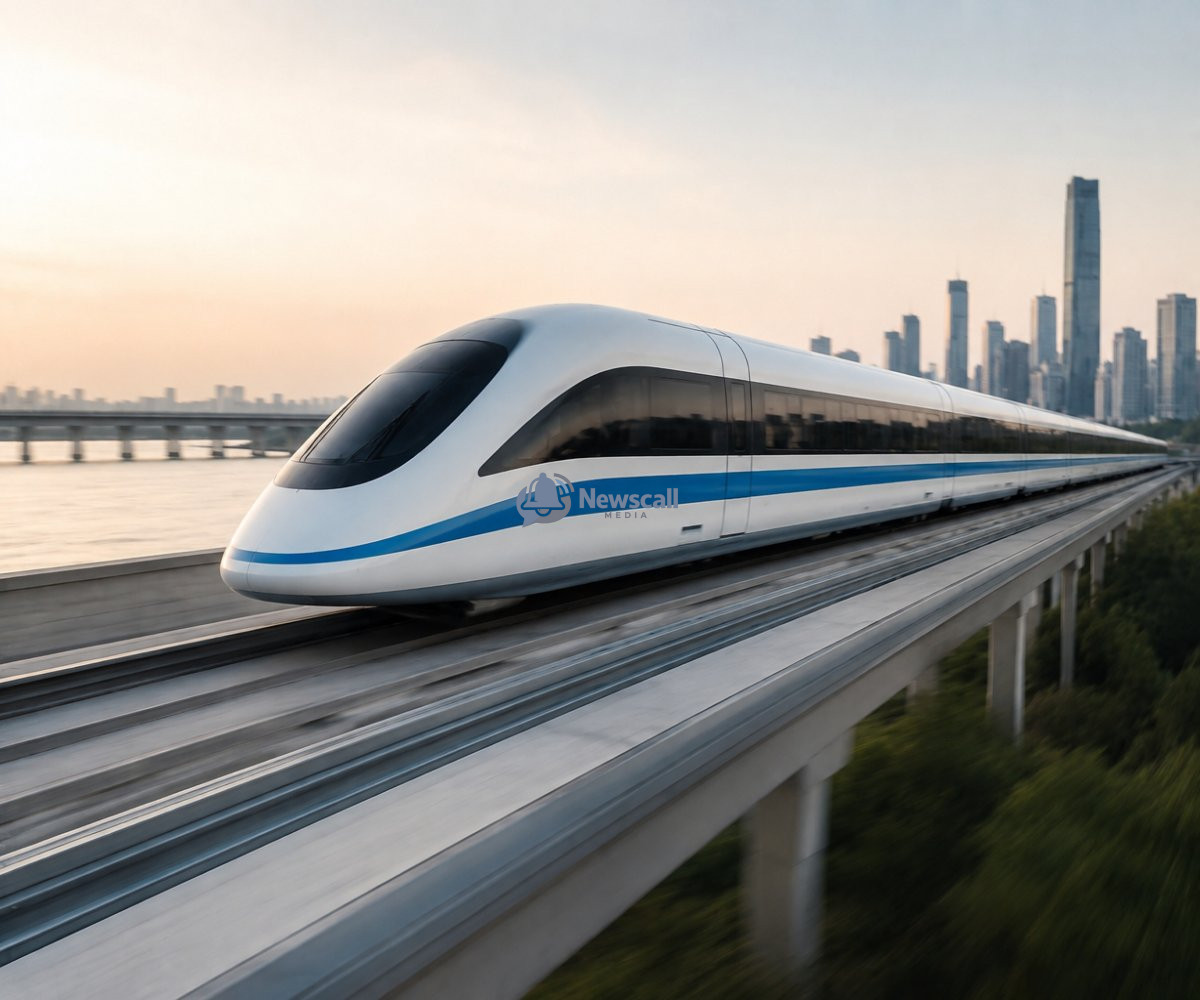
For nearly two hundred years, trains have moved the same way.
Steel wheels roll across steel rails, carrying millions of passengers and billions of tons of cargo every year. It's a system that helped fuel the Industrial Revolution, connected nations, and transformed global transportation.
It's also remarkably efficient.
Steel wheels on steel rails create far less friction than rubber tires on roads, allowing trains to carry enormous loads using relatively little energy.
But as engineers pushed trains to higher and higher speeds, they encountered a problem that couldn't simply be solved with bigger engines or stronger tracks.
The faster a train travels, the more its wheels vibrate, the more the rails wear, and the greater the challenge of maintaining stability and safety.
Eventually, engineers began asking an extraordinary question.
What if trains didn't need wheels at all?
What if they could glide above the tracks instead of rolling across them?
That idea led to one of the most remarkable engineering achievements in modern transportation—the magnetic levitation train, better known as the maglev.
Although it never leaves the ground, a maglev train does something that seems almost impossible.
It flies.
1. The Problem With Wheels
No matter how perfectly a railway is built, wheels and tracks are always in contact.
That contact creates friction.
Friction slows the train, wears down components, generates heat, and increases maintenance costs.
At conventional speeds, these problems are manageable.
At extremely high speeds, however, they become much more significant.
Tiny imperfections in the rail can create vibrations, and continuous contact gradually wears both the wheels and the tracks.
Instead of trying to eliminate these problems entirely, engineers wondered whether they could eliminate the contact itself.
2. Making a Train Float
The solution came from magnetism.
Magnets can either attract or repel one another depending on how they're arranged.
By carefully controlling these magnetic forces, engineers discovered they could lift an entire train several centimeters above its guideway.
Once the train rises off the track, something remarkable happens.
There is no rolling friction because nothing is touching.
The train simply floats.
Only air resistance remains to slow it down.
This makes maglev trains among the most efficient high-speed transportation systems ever developed.
3. How Magnetic Levitation Works
There are two primary types of maglev systems.
The first uses electromagnetic suspension (EMS).
In this system, powerful electromagnets attached to the train pull it upward toward the guideway. Sophisticated computer systems constantly monitor the tiny gap between the train and the track, adjusting the magnetic force thousands of times every second to keep the train perfectly suspended.
The second uses electrodynamic suspension (EDS).
Instead of attraction, this system relies primarily on magnetic repulsion. Superconducting magnets on the train interact with coils embedded in the track, naturally creating lift as the train gains speed.
Although the engineering behind these systems is incredibly complex, the goal is simple:
Keep the train floating smoothly and safely above the guideway.
4. A Motor Without Moving Parts
One of the most fascinating aspects of maglev technology is that many maglev trains don't carry traditional engines that turn wheels.
Instead, the track itself becomes part of the propulsion system.
Engineers install what is known as a linear motor along the guideway.
Unlike a conventional electric motor, which spins in circles, a linear motor creates a moving magnetic field that travels down the track.
The train is pulled forward by this invisible wave of magnetism.
Imagine cutting an electric motor open and stretching it into a straight line.
That's essentially how a linear motor works.
It's one of the reasons maglev trains can accelerate so smoothly and quietly.
5. Reaching Incredible Speeds
Without wheels scraping against rails, maglev trains can travel much faster than conventional rail systems.
Commercial maglev lines have already reached operating speeds of over 430 kilometers per hour (267 mph).
Experimental systems have exceeded 600 kilometers per hour (373 mph), making them among the fastest ground transportation vehicles ever built.
At those speeds, traveling between major cities could take a fraction of the time required by conventional rail.
For journeys of a few hundred kilometers, maglev technology has the potential to compete directly with air travel.
6. Why the Ride Feels Different
Passengers often describe riding a maglev train as strangely smooth.
There are no wheels crossing rail joints.
No constant rumbling beneath the cabin.
Very little vibration.
Instead, the train glides almost effortlessly along its path.
This smoother ride isn't just more comfortable.
It also reduces mechanical stress on the train itself, contributing to lower maintenance requirements over time.
7. If It's So Good, Why Isn't It Everywhere?
Given its advantages, it's natural to wonder why maglev hasn't replaced conventional railways around the world.
The answer is cost.
Maglev trains require entirely new infrastructure.
Existing rail lines can't simply be upgraded with stronger tracks.
New guideways, specialized electrical systems, advanced control equipment, and precision engineering must all be built from scratch.
For many countries, improving existing high-speed rail networks is currently more economical than constructing completely new maglev systems.
That said, several nations continue investing heavily in the technology.
China operates one of the world's fastest commercial maglev services, while Japan is developing next-generation superconducting maglev trains capable of even greater speeds.
These projects offer a glimpse into what the future of ground transportation could look like.
The story of maglev teaches an important lesson about engineering.
Sometimes the greatest breakthrough doesn't come from improving an old invention.
It comes from questioning one of its most basic assumptions.
For nearly two centuries, engineers assumed trains needed wheels.
Then someone imagined a train that could float.
Today, that idea carries passengers at breathtaking speeds without ever leaving the ground.
It's a reminder that innovation isn't always about reaching the skies.
Sometimes, it's about discovering that you never needed to touch the ground in the first place.
Hashtags:
#Innovation #Engineering #Maglev #HighSpeedRail #Transportation #Technology #Science #STEM #MechanicalEngineering #ElectricalEngineering #EngineeringMarvels #FutureTech #Infrastructure #Knowledge #MindCommunity

Victor Oluebubechukwu Akuma.
Creative writer