
From Artificial Intelligence to Space: Kevin Weil's Next Mission The world's biggest technology
l eaders are no longer looking only at artificial intelligence.
More and more of them are looking toward space.
This week, another example made headlines.
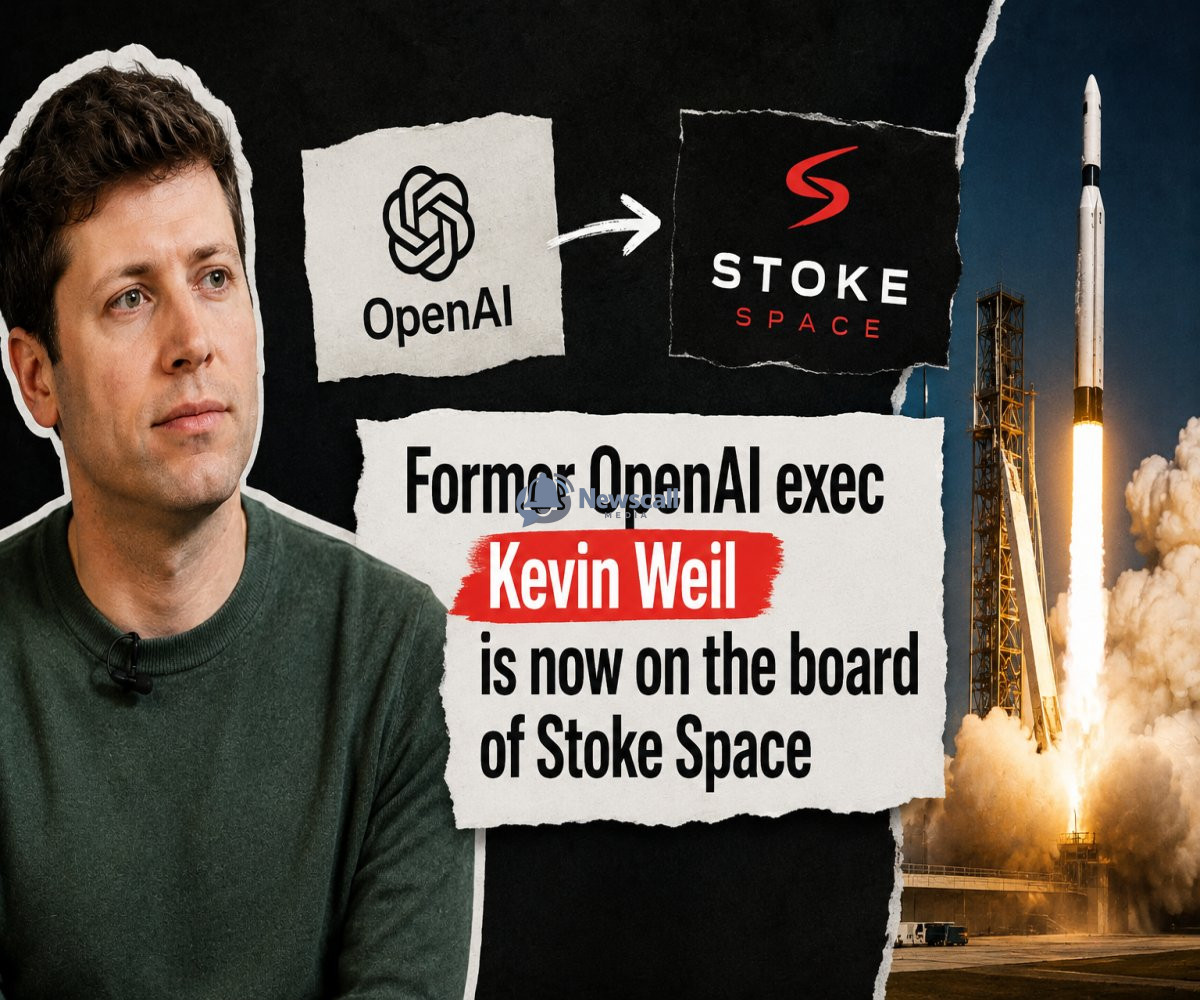
Kevin Weil, a former OpenAI executive and one of the most influential product leaders in Silicon Valley, has joined the board of Stoke Space, a startup developing fully reusable rockets.
At first glance, it may seem like an unusual move.
Why would someone known for helping build advanced AI systems join a space company?
The answer reveals something much bigger than one person's career.
It reveals where the next wave of innovation may be heading.
For years, artificial intelligence has dominated conversations about the future.
Companies have raced to build smarter models.
Governments have invested billions.
Businesses across every industry have begun adopting AI.
But another technological revolution has been quietly gaining momentum.
The commercialization of space.
Unlike the early days of space exploration, when governments led almost every mission, today's space industry is increasingly being driven by startups.
Companies are building reusable rockets, private satellites, lunar landers, and technologies designed to make space more affordable than ever before.
One of those companies is Stoke Space.
Founded in 2019, the startup has a bold ambition: to build rockets that are fully reusable.
That may sound like a small engineering improvement.
In reality, it could change the economics of spaceflight.
Traditionally, rockets are incredibly expensive because much of the vehicle is discarded after every launch.
Imagine buying a new airplane every time you flew.
That is essentially how space launches worked for decades.
Reusable rockets change that equation.
Instead of throwing away valuable hardware, companies recover it, inspect it, and fly it again.
The result is lower costs, more frequent launches, and greater access to space.
Companies like SpaceX have already demonstrated the power of this idea.
Now startups like Stoke Space want to take reusability even further by creating rockets designed to be reused almost entirely.
That is where Kevin Weil's appointment becomes interesting.
Throughout his career, Weil has helped build products used by millions of people, including leadership roles at Instagram, Twitter, Planet Labs, and OpenAI.
His expertise isn't rocket engineering.
It's building technology companies that scale.
As space startups mature, success will depend on more than engineering alone.
They will need strong leadership, world-class products, strategic partnerships, and long-term business planning.
That is exactly the kind of experience executives like Weil bring.
His appointment also reflects a broader trend.
The boundaries between industries are beginning to disappear.
Artificial intelligence is transforming healthcare.
Robotics is transforming manufacturing.
Space technology is becoming a commercial business.
Leaders who understand one frontier are increasingly helping shape another.
For entrepreneurs, there is an important lesson here.
Innovation rarely happens in isolation.
The skills developed in one industry often become valuable in another.
The future belongs to people who can connect ideas across different fields.
Today, Kevin Weil is joining a rocket company.
Tomorrow, more leaders from AI, software, biotechnology, and robotics may follow.
Because the next great technological breakthroughs won't come from a single industry.
They will come from the moment those industries begin working together.
The story isn't simply about a new board appointment.
It's about the growing connection between two of humanity's biggest frontiers.
Artificial intelligence.
And space.
As both industries continue to accelerate, the people building tomorrow's world may no longer stay in just one lane.
They'll move wherever the next great challenge takes them.

Victor Oluebubechukwu Akuma.
Creative writer